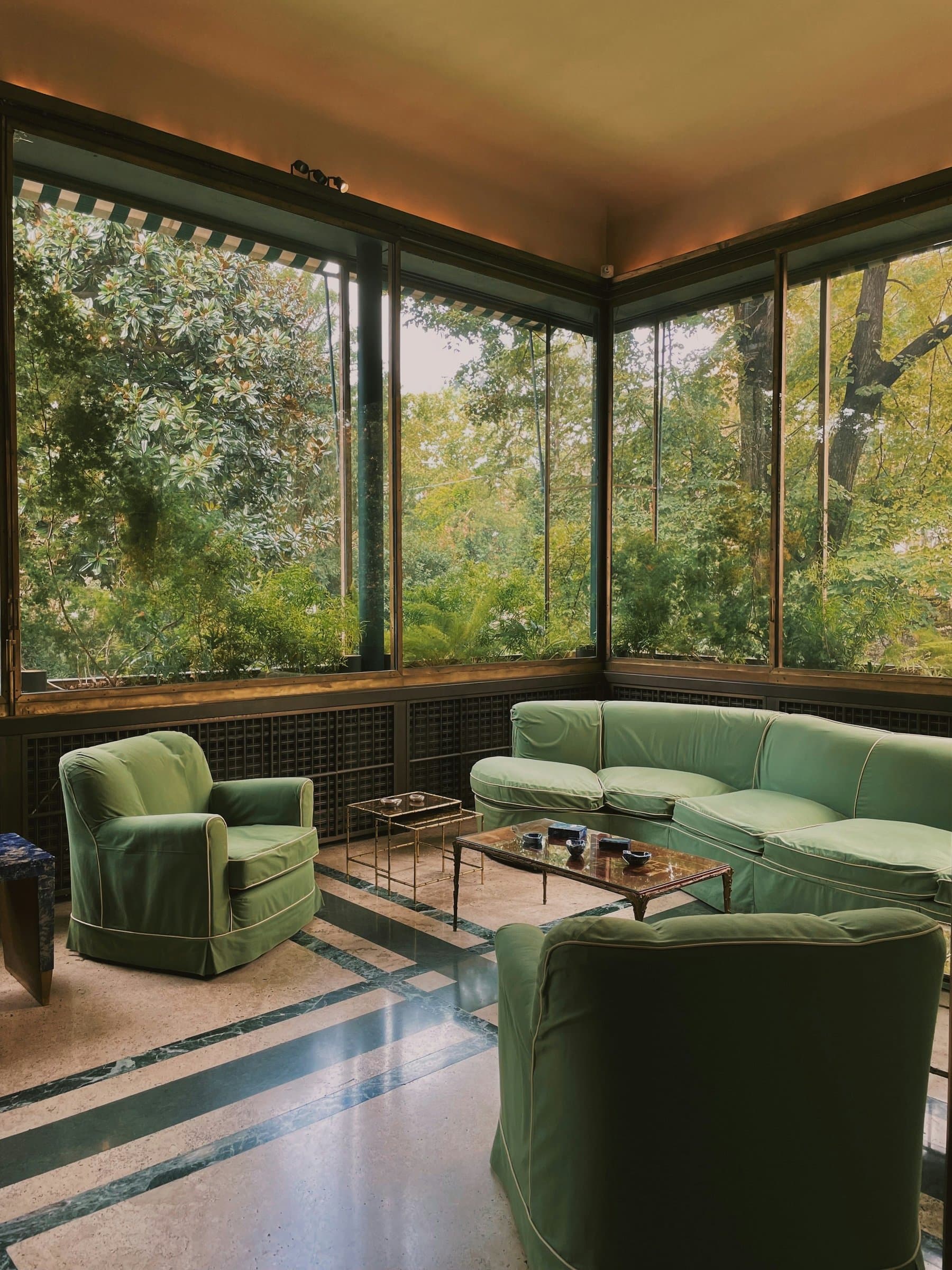
If one architect shaped the taste of the Milanese bourgeoisie between the wars, it is Piero Portaluppi. Born in 1888 and died in 1967, he built villas, palazzi and power stations, restored historic residences and led the Faculty of Architecture of the Politecnico for more than twenty years.
Walking through Milan you meet him constantly, even without knowing it.
The works everyone knows
- 1930
- the Ulrico Hoepli Planetarium, in the Porta Venezia gardens
- 1932–35
- Villa Necchi Campiglio, in via Mozart
- 1919–22
- the restoration of the Casa degli Atellani, in corso Magenta
Villa Necchi Campiglio, now owned by FAI, is the work that best expresses his idea of the home: an urban villa with garden, swimming pool and tennis court, where luxury is made of materials and details rather than size. The veranda, the marble vestibule, the handles, the brass grilles, the systems for darkening the windows: everything is designed.
A luxury made of details
Portaluppi worked on everything, from the façade to the lock. His palazzi share a few constants:
- Noble materials used with restraint: marble, fine woods, brass, never combined to astonish.
- Entrances and staircases as places of representation, with generous proportions and natural light.
- An elegant geometry, joining the classical tradition with suggestions of Art Deco and Rationalism.
- A subtle irony, in the decorative motifs and in unexpected solutions.
A Portaluppi home is not recognised by the signature on the façade, but by the way the front door welcomes you.
Living in a palazzo of the period
Beyond the most celebrated works, Milan has many residential buildings from those years, his own and those of colleagues who shared his language: in corso Venezia, in via Jan, around Magenta and Pagano, near the Porta Venezia gardens. The market values these homes highly today, for their ceiling heights, build quality and character.
Anyone buying one should first ask what remains of the original: floors, window frames, boiserie, handles, glass. A good restoration preserves them and upgrades systems and performance without erasing the history. A bad one replaces them, and with them part of the value.
Where to see Portaluppi
Villa Necchi Campiglio is open to the public, as is the Casa Museo Boschi Di Stefano, housed in a building he designed in via Jan. The Fondazione Piero Portaluppi keeps his studio and archive. A walk through these places is the best way to train the eye before looking for a home: it teaches you to tell what is precious from what is merely expensive.
Real estate advisor · Milan